Skyroot Aerospace: Reaching for the Stars from Hyderabad

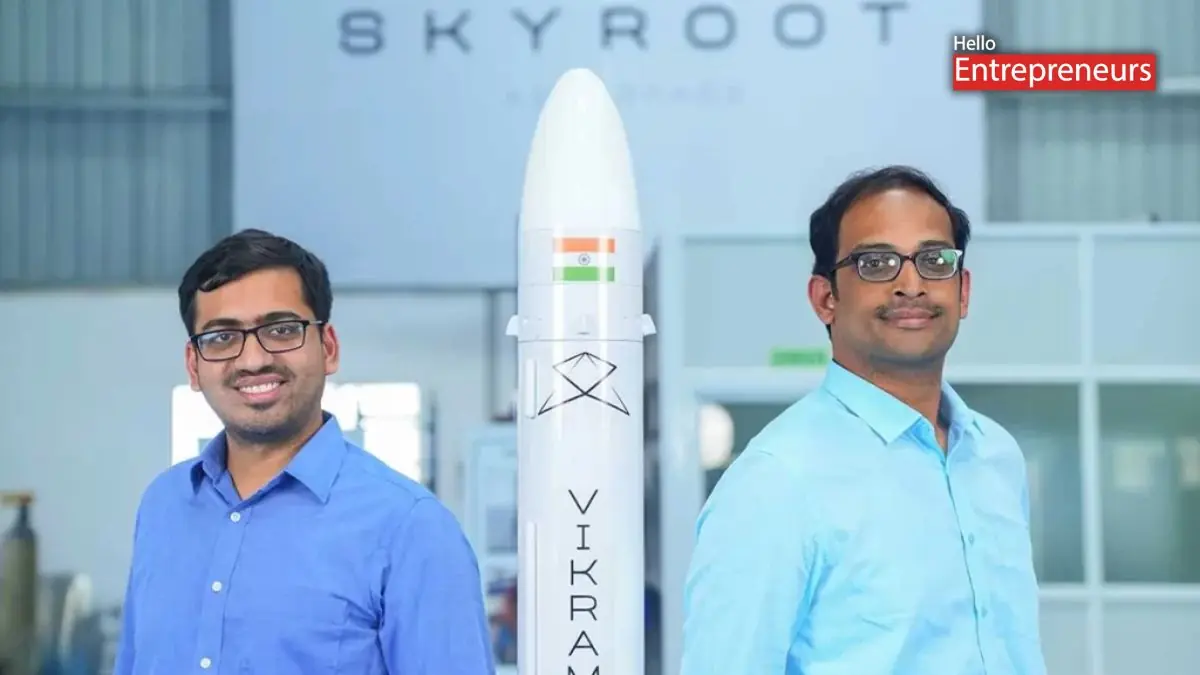
In a small office in Kondapur, Hyderabad, in July 2018, the two former ISRO scientists has asked themselves a reforming question: What if launching into space could be as accessible as commercial air travel? Pawan Kumar Chandana and Naga Bharath Daka founded tke Skyroot Aerospace with a massive vision to democratize space access, by transforming it from a government monopoly into an arena where the private innovations could flourish.
Starting with the just ten team members and initial funding of $4.3 million from investors including Solar Industries and CureFit founders Mukesh Bansal and Ankit Nagori, the duo embarked on an audacious journey. Both the IIT graduates who had spent years working on launch vehicle projects at ISRO, they brought deep technical expertise and an entrepreneurial spirit to build something unprecedented in India.
Breaking Barriers
Skyroot Aerospace became the first Indian startup that formally enter into an agreement with the ISRO for using its facilities when the Department of Space has signed a framework MoU in September 2021. This historic partnership came after India’s government opened the space sector to private players in May 2020, creating the regulatory framework that startups like Skyroot needed.
The momentum built rapidly. On November 18, 2022, Skyroot has performed the maiden launch of its Vikram-S suborbital rocket, and by this it becoming the first Indian private company to reach to the outer space with an apogee of 89.5 kilometers. Which is named as “Mission Prarambh”, it was more than just a successful test it was a declaration that India’s private space age had arrived.
Funding the Future
Confidence in Skyroot Aerospace’s vision has translated into the substantial financial backing. After that the company has raised approximately $95.5 million across multiple funding rounds, making it one of India’s most well-funded space-tech startups. Major investors include Singapore’s GIC, Greenko Group, and Google’s founding board member Ram Shriram. With over 500 employees as of 2025, Skyroot Aerospace has been grown from that small team of ten into a awesome organization by combining India’s space heritage with the startup agility.
The 2025 Milestone
November 27, 2025, marked Skyroot’s most significant achievement yet. Prime Minister Narendra Modi inaugurated the Infinity Campus, a 200,000 square foot facility in Hyderabad designed to manufacture, integrate, and test launch vehicles with the capacity to produce one orbital rocket each month.
At the same ceremony, the fully integrated Vikram-I rocket was unveiled India’s first fully private orbital-class launch vehicle, capable of placing up to 350 kg in Low Earth Orbit and launching within 24 hours of arrival at the pad. Named after Dr. Vikram Sarabhai, the father of India’s space program, Vikram-I represents the culmination of years of development in propulsion systems, including the company’s innovative 3D-printed cryogenic Dhawan-1 engine that uses liquefied natural gas.
The Infinity Campus itself is a statement of intent. This state-of-the-art rocket factory, has been located near Hyderabad’s international airport, houses integrated design, manufacturing, and testing infrastructure under one roof. It’s not just India’s largest private rocket facility it’s a symbol of what private enterprise can achieve in a sector traditionally dominated by governments.
Looking Ahead
Skyroot Aerospace has been declared Vikram-I “launch-ready” with their first mission which aimed for the February-March 2026 from Sriharikota. The company aims to capture 10% of the global small-satellite launch market by 2030, competing with established international players.
Beyond the commercial launches, Skyroot Aerospace has also signed an MoU with Axiom Space in June 2025 to collaborate on the integrated orbital and launch of the systems for missions to Axiom Station and other low-Earth orbit projects, creating new logistics corridors for research payloads and commercial ventures.
The Telangana government has also signed an agreement with the Skyroot Aerospace in January 2025 at the World Economic Forum to established an integrated private rocket manufacturing facility with an around estimated investment of Rs 500 crores, further by cementing Hyderabad’s position as India’s space-tech hub.
The Bigger Picture
Skyroot’s success story reflects India’s broader transformation. In Prime Minister Narendra Modi’s words at the Infinity Campus inauguration, the company has represent that how opening the space sector to the private players has unleashed youth power, entrepreneurship, and innovation. With India targeting dozens of launches per year by 2030, Skyroot is positioned to play a crucial role in that ambitious vision.
From carrying the rocket parts on the bicycles in the 1960s to now building the carbon-composite orbital rockets in year 2025, India’s space journey has come full circle. And for Skyroot Aerospace, the journey to the stars is only just beginning.
<p>The post Skyroot Aerospace: Reaching for the Stars from Hyderabad first appeared on Hello Entrepreneurs.</p>